


American Depositary Receipts (ADRs) were created to simplify foreign investing and offer an avenue for U.S. investors to diversify into foreign markets without having to purchase stocks on foreign exchanges. Exposure to many familiar dividend-paying companies around the globe can be achieved via ADRs, which typically trade on one of the large U.S. exchanges or in the over-the-counter market.
The following are some considerations investors should understand before adding ADRs to their portfolios.

ADRs are listed in dollars and are certificates issued by a U.S. bank representing shares the sponsoring bank buys of a foreign company. Each ADR reflects a fixed number of local shares, which may be fractional or multiple.
None of the companies on the current Dividend Informer coverage trade as ADRs, though several stocks are domiciled outside the U.S. but trade their shares on U.S. exchanges, such as Enbridge (ENB), Medtronic (MDT), NXP Semiconductors (NXPI), and Essent Group (ESNT).
ADRs serve to broaden the menu of potential dividend investments and can lead to stronger dividend portfolios, though investors should also be aware of the fees, potential tax implications, and other considerations.
Some companies available to U.S. investors through ADRs pay relatively attractive dividends, such as Nestlé (NSRGY) (dividend yield of ~3.5%), Shell (SHEL) (~4.0%), Unilever (UL) (~4.0%) and Toyota Motor (TM) (~3.5%).
As consumer staples stalwarts, Nestlé and Unilever fit the typical profile of a dividend stock. Both companies have a well-known portfolio of brands, and Unilever has raised its dividend for 43 consecutive years in its home currency.
Shell offers exposure to a large integrated energy company, and Toyota is the world’s top-selling car manufacturer. The list of ADRs paying dividends well in excess of the 1.1% currently offered by the S&P 500 extends well beyond the names listed above.
Before You Buy an ADR
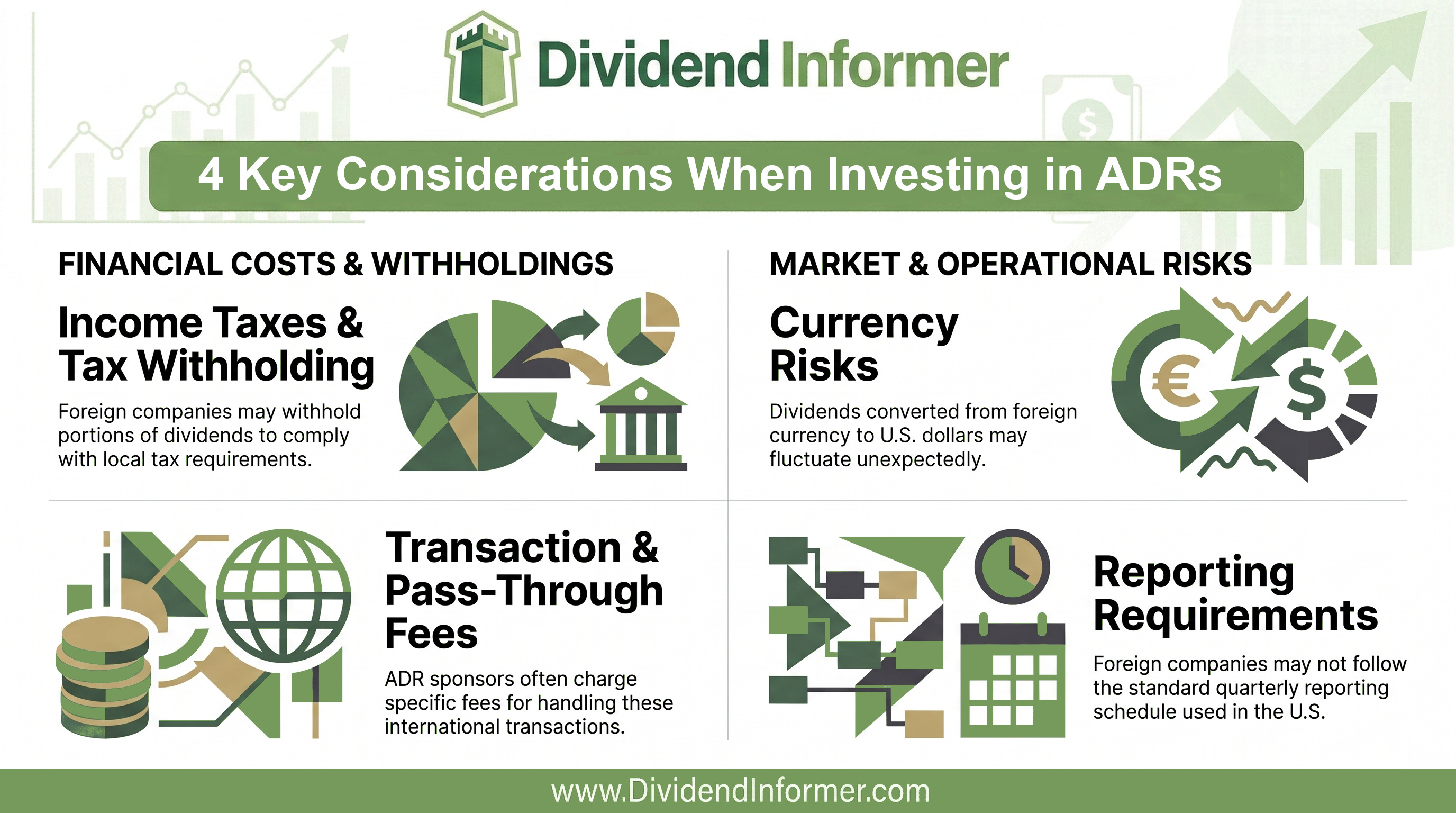
Banks that issue ADRs can charge quarterly or annual pass-through fees, covering custody and other expenses, including those associated with processing dividends. The issuing bank will collect dividend payments and convert them into dollars before distributing the dividends to ADR investors. Pass-through fees vary but generally run anywhere from $0.01 to $0.05 per ADR per dividend. If the ADR you are buying carries a low price, know that this can meaningfully eat into the headline yield. Information on applicable fees for any ADR is available from the custodial bank.
Taxes are also an important consideration. Foreign withholding tax means a lower payout, as withholding occurs before the dividend hits your account, regardless of account type. Rates can be as high as 35% in some countries, while others, like the U.K., are zero. The rate of withholding can also be reduced if the country maintains a tax treaty with the U.S. If the ADR is held in a taxable account, investors can typically claim a foreign tax credit for foreign tax withheld, but be sure to check with your tax professional.
Many ADRs are fairly liquid, but some are thinly traded. Be aware of average trading volumes and bid-ask spreads when looking to buy or sell ADRs.
Currency risk is another consideration. If the dollar strengthens relative to the company’s home currency, this lowers dollar-denominated payouts but can also work in investors’ favor if the dollar weakens relative to the home currency.
Finally, reporting requirements for ADRs vary depending upon the ADR program, which, for sponsored ADRs, is established in collaboration with the company. These can range anywhere from minimal reporting requirements to requirements that largely mirror those followed by U.S. companies. Many large foreign companies with ADRs fall into the latter category.
Increased choice is a good thing. Provided an investor remains mindful of the fees and other considerations associated with ADRs, these instruments can help expand the opportunity set for dividend investors, increase diversification, and generally lead to stronger income portfolios.
When evaluating ADR candidates, apply the same quality and valuation fundamentals — revenue and earnings growth, quality metrics and valuation — that guide any sound stock analysis.
About Dividend Informer
Dividend Informer delivers regular research and analysis on securities which provide a combination of income and long-term appreciation, aiming to reduce volatility while still delivering adequate investment returns. Each month, our professional stock analysts publish detailed, high-quality, income-oriented stock ideas for subscribers. These in-depth research reports are exclusive to the Dividend Informer newsletter.
A version of this article originally appeared in the September 2026 issue of BetterInvesting magazine and is reprinted by arrangement.
