


In this edition of the Dividend Informer, our analysts introduce a new dividend payer to our list of coverage. A recent acquisition looks to double its revenues and create opportunities for dividend growth and share buybacks.
Allison Transmission is a leading designer and manufacturer of propulsion solutions for commercial and defense vehicles.
The company has historically been generous in returning cash to shareholders via a combination of dividends and share repurchases, and we expect this will continue. The current yield is a modest 0.9%, but the company’s new expanded global presence makes the company’s prospects look quite promising.
It is the largest global manufacturer of medium- and heavy-duty fully automatic transmissions used in on-highway trucks, buses, motorhomes, off-highway vehicles and equipment, and defense vehicles. The company possesses a strong brand due to transmissions that are extremely durable and reliable.
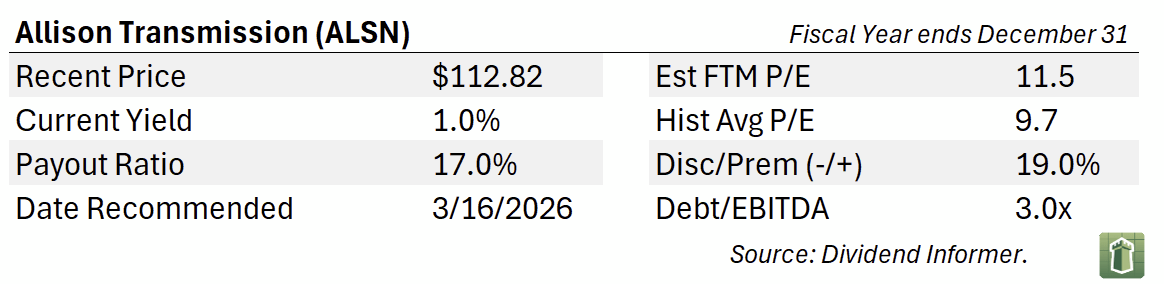
Allison was once part of General Motors before it was carved out and sold to private equity in 2007. The company returned to public markets in 2012, and its private equity investors exited their positions in 2014.
The company’s recently closed $2.7 billion acquisition of Dana Incorporated’s off-highway business comes with significant potential, as it provides Allison with access to new end markets while expanding its off-highway product offerings.
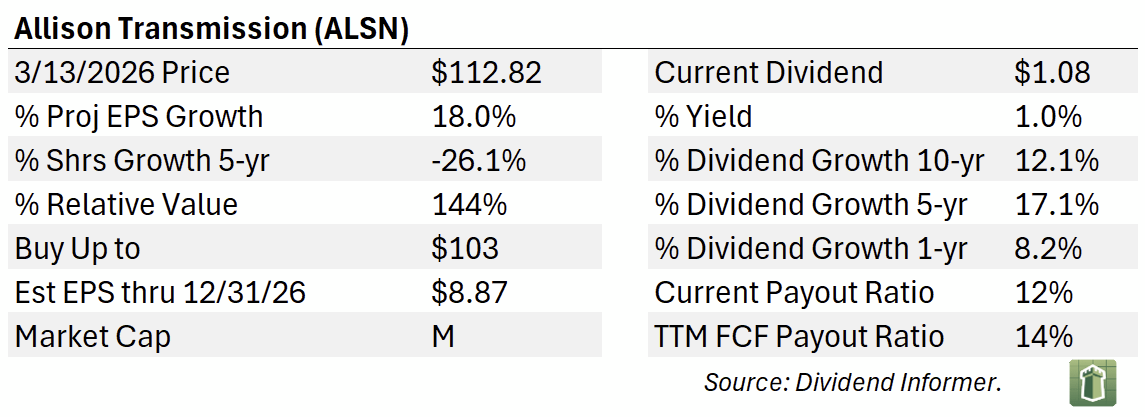
Overview
Allison introduced the world’s first fully automatic transmission to commercial vehicles more than 75 years ago.
The company retains a premium brand offering superior performance. End users frequently request Allison’s products by name and are willing to pay a premium. The company’s fully automatic transmissions run $3,000-$11,000 more than manual transmissions. However, due to their higher productivity, greater fuel efficiency, easier training, lower maintenance costs, and higher residual values, the average payback period is less than three years.
This has resulted in market share in North America exceeding 75% across school buses, Class 6-7 trucks, and Class 8 straight trucks.
Allison also boasts 50% market share in the motor home market. The company’s strong margin profile relative to its industrial peer group is an indication of Allison’s market position and the value it provides for its customers.
Despite a strong position in North America, automatic transmissions are less common in commercial vehicles globally. On-highway sales for Allison outside North America only account for a mid-teens percentage of overall sales, leaving ample opportunity for future growth. Over three quarters of the company’s sales prior to the acquisition of Dana’s off-highway business came from North America, the bulk of which related to on-highway.
Last June, the company announced the planned acquisition of Dana’s off-highway business for approximately $2.7 billion in cash, representing its largest ever acquisition. Including projected cost synergies of $120 million, the transaction value represented a 5.2x enterprise value-to-EBITDA. The transaction closed in early 2026 and is expected to be immediately accretive.
Aside from what appears to be a reasonable price tag, there are other key benefits for Allison from this complementary transaction. The acquisition expands Allison’s global footprint and deepens the off-highway end markets the company serves. Approximately 70% of Dana’s sales came outside of the Americas, and the acquired business meaningfully expands exposure to the industrial, construction and forestry, and agriculture end markets.
The combined entity will have approximately $6 billion in annual sales, about equally split between on- and off-highway markets, with about 5% of sales coming from defense end markets. Based on 2024 results, geographically sales will be split 56% Americas, 28% Europe, and 16% APAC, which is primarily India.
While management has only outlined cost synergies to date, it is reasonable to expect Allison will see some revenue synergies due to its ability to offer a wider range of commercial duty powertrain and industrial solutions to more customers and end users worldwide. Allison had highlighted a desire to expand its global presence, especially in emerging markets, which this acquisition provides along with access to adjacent end markets.
Given the longer-term cost of ownership benefits and the low penetration of automatic transmissions in commercial vehicles outside of the North American market, the international market remains a meaningful opportunity for Allison.
Importantly, the acquisition also comes with international manufacturing facilities that allow “local for local” production and offer platforms for future bolt-on acquisitions.
Scores
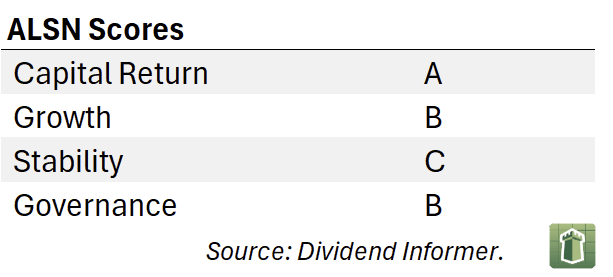
Capital Return: A
While the company’s headline dividend yield of just under 1% is not eye-grabbing, the company has two primary factors that have led us to assign the top grade.
First, it has grown its dividend nicely in recent years. Over the past six years Allison has increased its quarterly dividend by 80% in total.
Second, Allison has been a significant, consistent purchaser of its own shares over time. Since the company went public in 2012 it has bought back more than 65% of its shares outstanding. As of its most recent quarterly report, the company’s share count was down 5% versus the prior year. The company also has $1.2 billion remaining under its current share repurchase authorization.
On a combined basis, dividends and share repurchases result in a total shareholder yield of approximately 6%, reflecting generous capital return to shareholders that is supported by strong free cash flow generation.
The company added debt in conjunction with the Dana off-highway acquisition, and it plans to return to targeted debt levels over the near term. Debt paydown will serve as a claim on cash temporarily, though management has reiterated its commitment to return capital to shareholders.
Given its track record, we anticipate continued strong total shareholder yields that are biased to share buybacks but also include a growing dividend.
Growth: B
Allison is currently navigating headwinds in its core North American on-highway business, as its customers are managing uncertainties related to tariffs, evolving trade policies, and upcoming emissions regulations, in addition to broader economic uncertainties. This has resulted in more cautious purchasing decisions from its customers that have also impacted its competition, signaling its dominant market share remains intact.
Management has highlighted its view that the current reductions in demand in its North American on-highway business are simply a deferral of purchases by end users. Growth will be meaningfully helped by the Dana acquisition that nearly doubles the company’s overall sales. In addition, organic sales growth in the low- to mid-single digit range appears achievable given revenue synergies enabled by the recent acquisition.
This should also be supplemented by bolt-on acquisitions facilitated by new international platforms. We anticipate EPS growth will outpace sales growth as the company achieves cost synergies and repurchases shares.
Stability: C
Management highlights that approximately 30%-40% of Allison’s North American on-highway market volume is driven by municipal spending, reducing end market volatility. However, some of the markets in which Allison operates, including energy, mining, construction, distribution, and motorhomes, are highly cyclical.
The company also continues to face risks from the electrification of commercial vehicles. The company has made investments to address electrification and offers a portfolio of electric products, but a shift away from internal combustion engines could prove disruptive. This overhang has likely weighed on the company’s valuation multiple.
That said, the company today boasts strong market share and has shown an ability to navigate a variety of markets. Though the company took on additional debt with the Dana acquisition, leverage at 3.0x is manageable for a company with strong free cash flow generation. We expect this will allow for rapid debt reduction and the company is targeting 2.0x leverage in the near term.
While capital return to shareholders has been robust, Allison has comfortably covered the payouts.
Considering buybacks and dividend payments in aggregate, the company’s payouts in recent years have not exceeded two-thirds of net income, and in certain years have been below 50%, offering some cushion.
Governance: B
The company’s board is comprised of individuals with relevant experience, and the vast majority of the board is composed of independent directors. Every director stands for election annually, also a positive.
One potential issue is the company combines the CEO and Chairman roles, as David Graziosi has served as CEO since 2018 and he added the Chairman role in 2021.
Executive compensation includes both short- and long-term incentives. The company typically uses a mix of net sales, adjusted EBITDA margin, and adjusted free cash flow for annual incentives. Long-term incentives incorporate total shareholder return, benchmarking Allison’s performance against a relevant peer group consisting of industrial companies.
The company also has clawback provisions and stock ownership guidelines to keep interests aligned.
Over time Allison’s capital allocation decisions have been sensible and the rationale behind the recent Dana off-highway acquisition also appears sound.
Allison Transmission Holdings, Inc. is listed on the NYSE under the symbol ALSN.
Website: ir.allisontransmission.com
