


Hello, informed dividend investors!
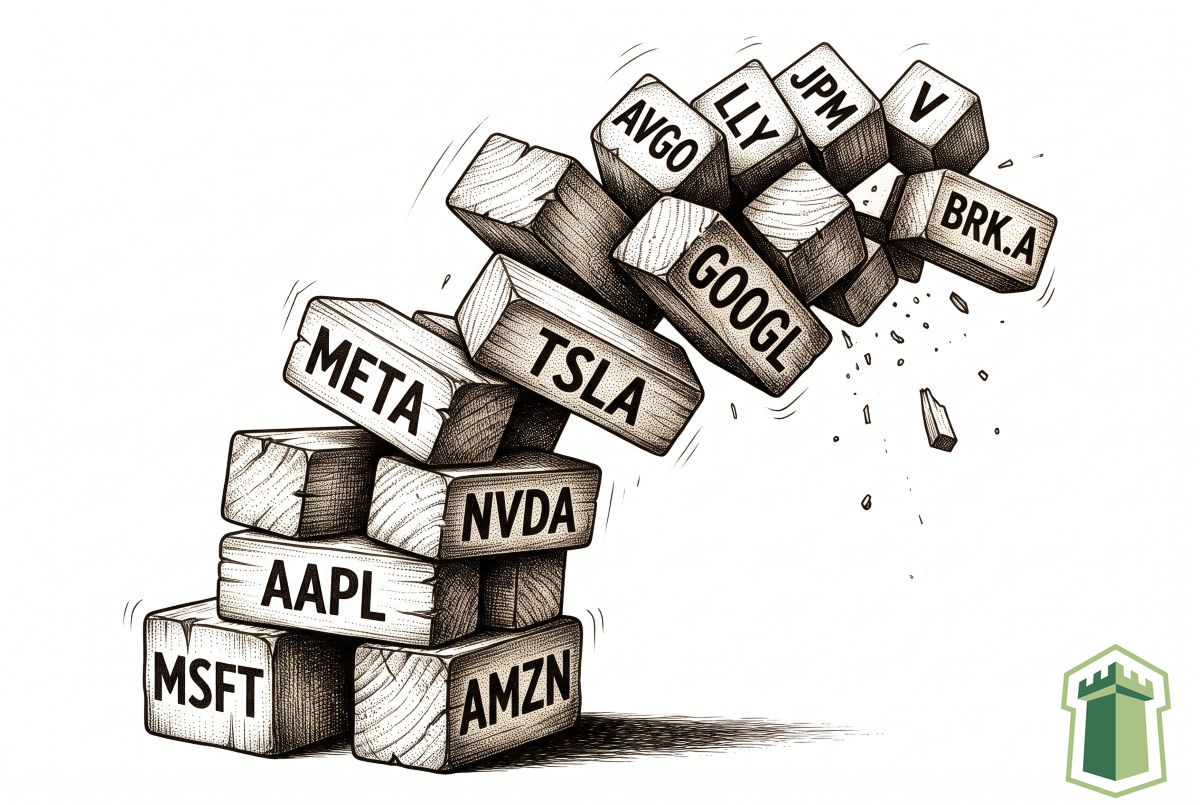
It remains a narrow market led by AI-related names. Despite the S&P 500 trading near all-time highs, the median stock is down by a mid-teens percentage from highs.
Key technical indicators also reflect individual stocks are not experiencing the same strength as the index. At the end of the third quarter, just 43% of stocks were trading above their 200-day moving average while only 25% of S&P 500 constituents were trading over their 50-day moving average.
If you have any questions about our approach to dividend total return investing, please reach out — I’d love to hear from you!
And now, read on for our team’s thoughts on the current state of the market and economy.
Here’s to your continuing investing success!

Three Takeaways for Dividend Investors
Real yields have broken out. The 10-year Treasury near 5.10% and real rates at 2007 levels leave the S&P 500’s dividend yield of just over 1% looking less competitive.
The market remains narrow. Ten stocks account for about 40% of the S&P 500, and the median stock is down by a mid-teens percentage from its highs.
Dividend stocks offer exposure beyond AI. Companies with durable earnings growth and reasonable prices give income investors access to the broader economy.
The Stock Market
In the third quarter, it was back to large tech leading the way, with the Magnificent Seven up 11% versus the market-cap-weighted S&P 500 advancing a more modest 2% and the equal-weighted S&P 500 down 2%.
Small caps, which are more sensitive to higher rates, fell 7%. Though we have seen brief periods this year where strong market performance has broadened out, lately it has been a replay of the same old theme.
Ten stocks account for approximately 40% of the index, and Microsoft, Nvidia, Apple, and Meta accounted for 200% of the index gain in Q3. According to a recent report from JPMorgan, since January 2024 when the AI trade started to take off, a basket of 42 AI stocks accounted for 60%-80% of all S&P 500 earnings growth, price returns, and capital spending. Over the past three years, only 30% of stocks outperformed the S&P 500 index.
Despite damage under the surface, market rotations have kept overall volatility muted. The CBOE Volatility Index has remained in the mid-to-low teens, reflecting relative index-level calm. The recent day-to-day price action suggests the market is moving at least as much on rotational dynamics as on underlying company fundamentals, though this is unlikely to be a long-term phenomenon.
While AI-related concerns occasionally weigh on markets, the AI trade remains the primary driver of the index. Company investment behind AI remains full-go, with Alphabet, Amazon, Microsoft, and Meta projecting over $1 trillion in capital expenditures in 2027 alone, up about one-third from 2026.
For comparison, the aggregate capital expenditures for these companies in 2022 was approximately $150 billion. Confidence that these massive expenditures will ultimately pay off continues to be key for the overall health of the market.
The Economy
The economy continues to experience strong nominal growth aided by AI-related investments and elevated deficits. Bloomberg estimates AI-related investments accounted for approximately half of the U.S.’s roughly 2% real GDP growth over the past year.
The September jobs report showed the labor market remains generally healthy, though nonfarm payrolls increased just 29,000, below expectations of closer to 90,000, with a 60,000 aggregate downward revision to jobs added over the prior two months. The economy remains in a low-hire, low-fire environment. The unemployment rate unexpectedly ticked slightly higher to 4.2%, though this partly reflected an increase in the participation rate to a four-month high, a positive development.
Consumers continue to manage elevated oil prices. Brent crude is trading above $100 a barrel, up from about $70 in February, just prior to the Iran conflict. A combination of higher energy prices and interest rates is weighing on consumers, with consumer sentiment recently hitting its lowest level in five months.
Still, consumers continue to open their pocketbooks, with spending in August rising at the fastest pace in over a year. There are concerns that at some point the remarkable consumer resiliency will wobble given higher overall inflation and slowing wage growth. Average hourly earnings, adjusted for inflation, declined in September from a year earlier for the sixth consecutive month. Consumer stocks already reflect some investor concern and collectively have significantly underperformed the S&P 500 this year.
With a solid labor market and ongoing concerns regarding stickier-than-expected inflation, the Federal Reserve raised interest rates for the first time in three years at its September meeting. The quarter-point increase raised the target range for the federal-funds rate to 3.75%-4.0%. Chairman Warsh indicated that one of the reasons for the increase at the September meeting is the economy appears to be strengthening.
The September CPI report showed consumer prices advanced 3.7% on an annual basis and 2.6% excluding food and energy. The hotter-than-expected report was due to broad-based price increases and boosted expectations for rate hikes over the coming year. Inflation data will be closely scrutinized going forward to determine the Fed’s rate path, which remains highly uncertain.
Markets are currently pricing in one more quarter-point hike in 2026 with three to four total quarter-point increases over the next year. It is unclear how effective rate increases will be in pumping the brakes on the parts of the economy driving inflation. The AI race is viewed by many companies as existential, so a few quarter-point rate increases are unlikely to slow investment. Higher rates do hit households, most notably middle- and lower-income consumers, making for a tricky balancing act for the Fed, which has signaled its seriousness about returning inflation to its 2% target after running above that level for more than five years.
Rates & Yields
Given strong underlying growth and elevated inflation, it is unsurprising that interest rates have moved higher. Yields on the 10-year Treasury have historically tracked annual nominal GDP growth, which as of the most recent reading is running over 6%. The 10-year Treasury yield reached its highest level in 24 years and after peaking at just over 5.3% has settled around 5.0%, up from approximately 4.2% at the start of the year.
The increase has put upward pressure on mortgage rates, with the average rate on 30-year mortgages at approximately 7.3%, up from 6.3% a year ago.
The increase in real rates, which excludes the impact of inflation, underscores the contribution of stronger growth to the rise in yields. 10-year real rates have broken out to levels last seen in 2007. Higher rates have pressured multiples and diminished the relative attractiveness of dividend stocks with the yield for the S&P 500 at just over 1%.
The forward multiple on the S&P 500 is 19x, down 15% from the highs earlier this year and approximately in line with the 10-year average. The equal-weighted S&P 500 index trades at 16x forward earnings, down 13% from 2026 highs. Earnings have driven the market higher.
Conclusion
As always, there are plenty of risks to point to, including the durability of the AI trade, inflation, higher rates, and uncertainty related to the midterm election. Further, the Anthropic IPO, currently expected in November, reportedly is targeting a valuation in the $2 trillion range after OpenAI delayed its IPO until 2027. Investors are increasingly focused on whether capital markets can support the amount of money that needs to be raised via both debt and equity to continue the hefty level of AI-related investment expected over the next few years.
The good news is that the rise in the index year to date has been driven by strong fundamentals with robust reported earnings growth combined with upward earnings revisions. After 34% earnings growth in Q2, consensus estimates reflect 25% growth in Q3 with those estimates increasing over the past two months is a sign of growing confidence. 2027 consensus expectations reflect approximately 16% earnings growth with estimates also moving higher since the start of the year. This would be a strong follow-up to expected earnings growth of over 30% this year.
Though the market has been relatively narrow and largely focused on AI, for dividend investors it remains sensible to also look for companies offering access to the broader economy with durable earnings growth and reasonable prices. A diverse portfolio of dividend-paying companies combining these exposures remains a reasonable way for income-oriented investors to position for the long term in a challenging environment.
Our team’s search continues for well-managed companies at fair prices that can grow in any environment, especially when the going gets tough.
Here are our two most recent selections for stocks that meet rigorous standards for quality, reduced volatility, and reasonable returns in the face of choppy markets:

