


Hello, informed dividend investors!
Higher headline yields may be an issue for governments, but the effect on the real economy is muted so far. As the Federal Reserve resumes interest rate increases and as credit spreads run out of room to fall, the move in interest rates should have more effect on the real economy going forward.
The stock market displays few concerns about an economic slowdown, but a market that briefly experimented with dispersion has retreated back into the shell of concentrating ever more nominal wealth solely into the technology complex.
If you have any questions about our approach to dividend total return investing, please reach out — I’d love to hear from you!
And now, read on for our team’s thoughts on the current state of the market and economy.
Here’s to your continuing investing success!

Three Takeaways for Dividend Investors
Dividend yields have hit record lows. The S&P 500's yield fell below 1%, the NASDAQ 100's below 0.5%, and the Dow's to 1.4%, making selectivity more important than ever.
The Fed raised rates instead of cutting them. Stubborn inflation forced a quarter-point hike to a new 3.75% lower bound, reversing the rate cuts investors expected coming into the year.
Tighter credit spreads are cushioning the real economy. Even as sovereign bond yields climb, narrower mortgage and corporate spreads mean borrowers haven't felt much of the pain yet.
The Stock Market
Technology stocks reasserted themselves over the past month. 2026 had previously seen a dispersion of gains into sectors left behind by the multi-year technology rally. Over the past month the only sector showing appreciable gains is Technology. As a result, the indices are still hovering at all-time highs.
But active stock pickers mostly lost a round to the more tech-concentrated passive investors. We may be witnessing a battle between the old guard and a new one, or maybe the brief period of dispersion was simply a false signal.
The Economy
The all-item CPI rose 3.4% in 12 months through August and is likely to rise further as oil prices have returned to levels last seen when the war in Iran was still daily news. Most analysts favor the core CPI, which ignores food and energy price fluctuations and was 2.4% over the past twelve months. However, we repeat what we said last month that energy tends to work its way into core prices with a lag.
Meanwhile, companies have received over $100 billion of tariff refunds, with an estimated $70 billion more to be returned. The tariffs were inflationary, and it stands to reason that the refunds are disinflationary. This effect might be viewed as a temporary headwind to prices, while energy represents an upward pressure which may or may not be equally temporary depending on what happens next with energy markets.
As the U.S. approaches midterm elections, prediction markets call control of the Senate a coin flip and control of the House a likely Democratic win. President Trump weighed in, promising $5,000 “citizen dividends” to be paid contingent on Republicans retaining both halves of Congress. The price tag would be over $1 trillion. The bond market understands that this level of fiscal stimulus would complicate the Fed’s job of fighting inflation and place upward pressure on rates.
Deficits are always tomorrow’s problem, but one area where tomorrow is fast approaching is Social Security. The program faces a 22% benefit cut in about five years unless Congress finds a way to increase revenue. Practically speaking, that means higher payroll taxes, with the marginal increase likely to affect high earners disproportionately. The graduated income tax, which is perceived to pay for government services, gets a lot more press, but the much flatter payroll tax, which is perceived to pay for entitlements, is at least as important. We say “perceived” because at the end of the day all taxes are taxes, and all spending is spending.
Rates & Yields
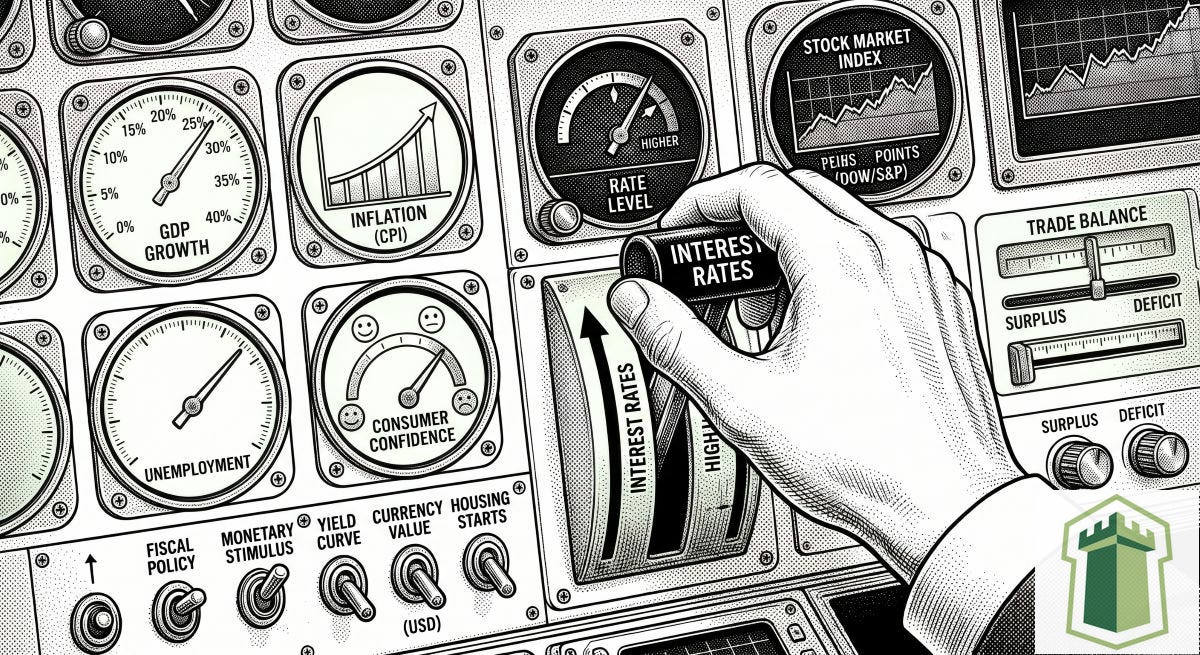
The Federal Reserve voted to increase overnight lending rates by 0.25% to a new lower bound of 3.75%. The Fed started cutting rates two years ago in September 2024. Coming into the year, expectations had been for continued rate cuts, but stubborn inflation underpinned by constructive economic data and a rising stock market have forced the Fed’s hand.
Long-term rates have not vacillated like the Fed has. They have continued to go in one direction, up. The yield on the 30-year Treasury shot up from 1% to +5% from early 2020 to late 2023.
As the yield seemed to plateau around that level for two years many analysts projected a future decline. Instead, long yields are on the rise again. The 30-year crossed 5.4% in September. The 10-year crossed 5% for the first time since 2007. Inflation is sticky. Rates are rising. The bond vigilantes are snarling.
Except that’s not the whole story. When pundits refer to rising interest rates they are usually talking about the rates paid by national governments on their sovereign debts. Those rates vary according to forecasts for growth, the value of the national currency, as well as investors’ assumptions about default risk, which is typically small but non-zero. Generally speaking, sovereign bonds benefit from their sponsors’ tremendous power to tax and to print money. Borrowers without their own prisons, armies, or monetary authorities pay a premium above government rates, called a spread, and those spreads have come down, cushioning the practical economic effects of those headline rate increases.
Mortgage spreads in the U.S. peaked at 3% in early 2023 and are presently below 2%. They could well fall further, as they have spent much of the past thirty years closer to 1.5%.
Credit spreads on high-yield, or “junk,” bonds have also narrowed and now sit near the low end of their historical range at about 2.75%, compared with a long-term average of about 5%. These probably don’t have a lot more to give. Investment-grade debt has behaved the same way although on a compressed scale because yields are lower than junk bonds.
If a rate rises in the forest but nobody pays more interest, does it make a sound? The mortgage market has been cushioned against 1% of the increase in government rates, while corporate borrowers have been cushioned against about 2%. Headlines about housing market pressure could be prescient but currently feel like clickbait. 30-year fixed mortgages at 6.8% are only at about their average of the past 4-years. The same is true for corporate yields, with the exception of the riskiest CCC-rated bonds and below.
From an economic perspective, rising rates are a sovereign government problem. Homebuyers and corporations continue to experience a post-pandemic status quo. Borrowers may be demanding higher yields to compensate for the (mainly) inflationary risks of government bonds, but the practical effect on the real economy remains minor so far. One interpretation is that the stimulative effects of deficits are about as credit positive for borrowers as they are inflationary, and the two forces offset each other.
A strong stock market keeps a cap on dividend yields. The S&P 500's dividend yield dropped below 1%. The NASDAQ 100's is less than 0.5%. Even the venerable Dow 30 yields just 1.4%.
Dividend investors can still find yield, but they have to be selective. As always, we advocate looking for a combination of yield and quality. Reaching for the highest yields on the board generally produces poor results.
Conclusion
Accommodative fiscal and monetary policy and torrid reported earnings growth pave the way for steady stock market gains.
Investors may wonder at what level all the good news is priced in, and we agree that certain market sectors may be priced beyond perfection. However, valuations do not look unreasonable where the underlying earnings can be sustained.
As always, we preach earnings growth and diversification. Don’t let your portfolio become too reliant on the continued strength of the stocks making all the news.
Our team’s search continues for well-managed companies at fair prices that can grow in any environment, especially when the going gets tough.
Here are our two most recent selections for stocks that meet rigorous standards for quality, reduced volatility, and reasonable returns in the face of choppy markets:

