


The next quarterly report arrives, and — no surprise to an expert stockpicker like you — the company beats both revenues and earnings estimates. Yet, as the next day’s opening bell rings, the stock price immediately plunges!
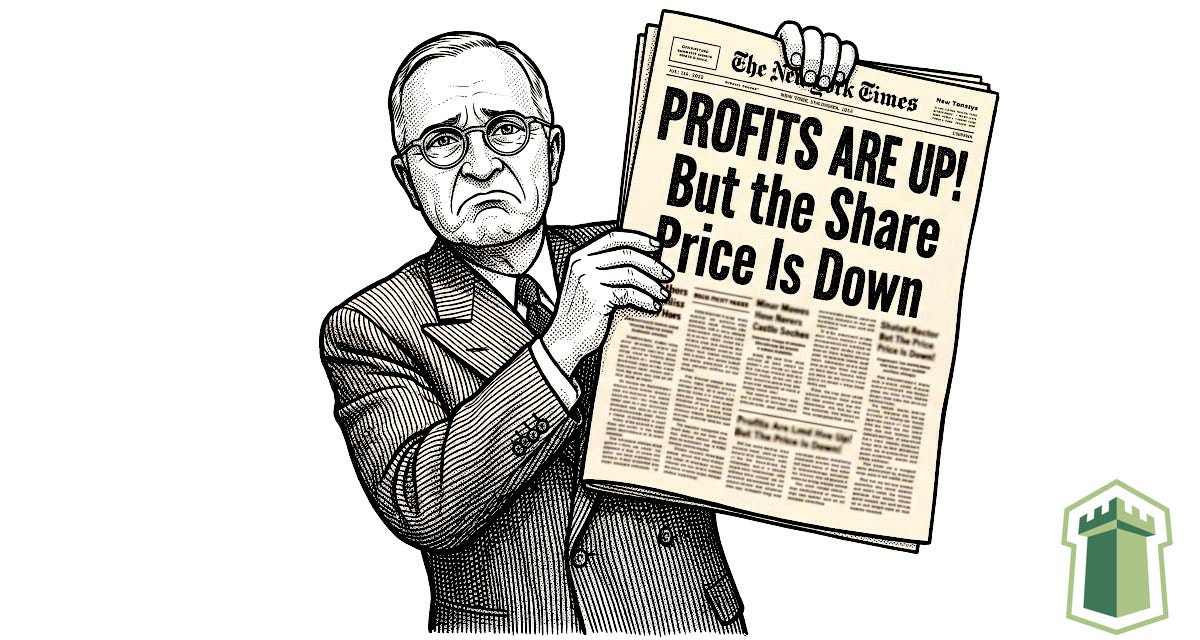
For investors, this counterintuitive performance can be unsettling. That said, such market dynamics are structural rather than accidental, driven by an interplay of asymmetric information, elevated baseline expectations, and the volatility inherent in investing.
A stock's price represents a continuous auction of future hopes, not a score card of its history.
THE ECHO CHAMBER OF "WHISPER NUMBERS"
A main culprit behind a post-earnings drop is the discrepancy between actual reported numbers and "whisper estimates." By definition, whisper numbers are unofficially collected or published but represent the market’s “mood” or “feeling” about a company’s expected earnings. These unspoken outlooks can sometimes be discovered by reading between the lines of an analyst’s report in which the confident tone of the research is tempered in the calculation of the published earnings estimate.
It’s common for small-cap stocks in particular to have much sparser coverage than larger companies, with only a few analysts covering them compared to dozens for an S&P 500 mega-cap. This thin coverage creates an informational vacuum where true market expectations — the whisper numbers — drift higher than the published consensus.
Then, even when a company reports results that match or even exceed the consensus, the number may still fall short of the higher, unrecorded expectation. For followers of the Efficient Market Hypothesis, this dynamic isn’t surprising. According to Eugene Fama's theory, prices immediately adjust to reflect all publicly available information. If buyers have spent weeks bidding up a small-cap because they expected a spectacular quarter, a merely "good" quarter represents a disappointment. The market had already pulled the future upside into the present, leaving no margin for error.
THE WEIGHT OF FORWARD GUIDANCE
Stock valuation is inherently forward-looking. The value of a stock is driven by an expectation of future results. Consequently, backward-looking financial statements — even those detailing impressive growth — take a back seat to management’s forward-looking guidance.
Consider a scenario where a company posts striking results, but management offers unimpressive guidance in its report, citing supply chain delays, rising labor costs or deceleration in customer acquisitions. Investors will immediately adjust their models, and a small cap trading at an elevated price-earnings ratio (P/E) can see a violent contraction.
A stock's price represents a continuous auction of future hopes, not a scorecard of its history. When historical data clashes with downward future guidance, the market will always prioritize the path forward.
THE ANATOMY OF "SELL THE NEWS" PROFIT-TAKING
Another force driving prices downward after good news is the classic market adage, "Buy the rumor, sell the news." Traders often buy shares based on anticipated positive events. After news is made public, the catalyst for further upward momentum disappears and traders utilize the volume that accompanies earnings day to exit positions and lock in their gains.
When a flood of these profit-taking orders hits the market simultaneously, it overwhelms the buying demand from investors who are reading the positive headlines. This concentrated block of profit-taking sell orders creates immediate downward price gaps.
Stocks don't trade in isolation; they're bundled by institutional algorithms into exchange-traded funds, sector buckets and quantitative risk models.
INDUSTRY CONTAGION AND SYMPATHY DROPS
Finally, a company can post outstanding numbers and still see its stock decline if industry peers report negative news. Stocks don’t trade in isolation; they’re bundled by institutional algorithms into exchange-traded funds (ETFs), sector buckets and quantitative risk models. If a sector bellwether reports weak demand or structural headwinds, investors will derisk the entire industry, dragging down healthy firms in the process. All participants in that group are presumed to be eventual victims of those macroeconomic pressures, regardless of their management or balance sheets.
When a retail giant warns of a slowdown in consumer spending, small-cap suppliers or specialized niche retailers see prices plunge, even if they have been delivering resilient growth. The market reacts defensively, pricing in industry headwinds before they show up in company financials.
MAINTAINING PERSPECTIVE ON THE SSG
For investors using fundamental analysis, short-term post-earnings declines can be viewed as opportunities rather than failures. If a stock drops despite posting solid growth, and management's long-term strategy remains sound, the underlying company has become cheaper while fundamentals have improved.
By tuning out the noise of whisper numbers, short-term profit-taking and sector panic, disciplined investors can use these market inefficiencies to add to high-quality positions at far more attractive valuations.
About Dividend Informer
Dividend Informer delivers regular research and analysis on securities which provide a combination of income and long-term appreciation, aiming to reduce volatility while still delivering adequate investment returns. Each month, our professional stock analysts publish detailed, high-quality, income-oriented stock ideas for subscribers. These in-depth research reports are exclusive to the Dividend Informer newsletter.